
Top 10 Best Email Marketing Platform for Small Businesses

In today’s fast-evolving digital world, email marketing remains among the most powerful and affordable ways for small businesses to reach and communicate effectively with their audience.
Otherwise social media or paid ads, email offers a personal and direct connection with customers — allowing businesses to build trust, drive consistent sales, and strengthen long-term loyalty.
Choosing the right email marketing platform isn’t always easy. Every tool brings its own mix of features, pricing, and automation — crafted to serve everyone from first-time users to professional marketers aiming for precision and performance.
After exploring this post, you’ll know exactly which platform offers the best balance of price, performance, and simplicity — so you can focus on what matters most: growing your business or Blog.
|
Email Marketing Platform
|
Best for
|
Rating
|
Pricing/month |
Free / Trial |
|---|---|---|---|---|
 |
best all-rounder for small businesses & Blogger |
4.5/5 |
$13 only |
Yes, Free Plan up to 500 contacts |
 |
Creators & bloggers |
4.6/5 |
$15 only |
Yes, Free Plan up to 300 subscribers |
 |
Automation & CRM |
4.6/5 |
$29+ |
Yes, 14-day free trial |
 |
All-in-one marketing & scaling |
4.5/5 |
$25+ |
Yes, Free Plan available |
 |
Affordable & multi-channe |
4.3/5 |
$25+ |
Yes, Free Plan up to 300 emails/day |
 |
Funnels & webinars |
4.4/5 |
$19+ |
Yes, 30-day free trial |
 |
Event-based & support-focused |
4.2/5 |
$12+ |
Yes, 60-day free trial |
 |
E-commerce & analytics |
4.5/5 |
$20+ |
Yes, Free Plan up to 250 contacts |
 |
Simplicity & design |
4.3/5 |
$10+ |
Yes, Free Plan up to 1,000 subscribers |
 |
Multi-channel & automation |
4.5/5 |
$16+ |
Yes, Free Plan available |
1. Mailchimp
best all-rounder for SMBs and straightforward growth
Overview
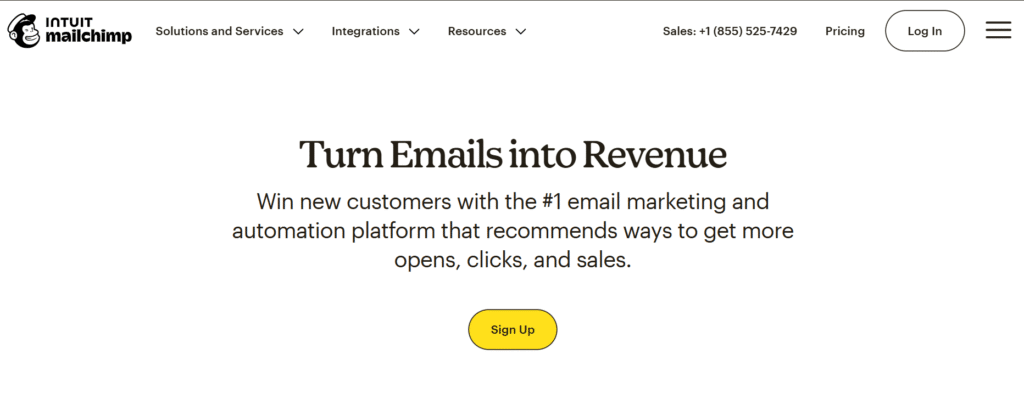
Mailchimp is one of the most widely adopted email marketing tools,It blends simplicity and strength. Its user-friendly design, extensive integrations, and automation capabilities make it perfect for small businesses, bloggers, and entrepreneurs looking to engage their audience and drive revenue.
🔑Key Features of Mailchimp
- Drag-and-Drop Email Builder: Design sleek, professional emails effortlessly—no coding required—using ready-made templates or your own custom layouts.
- Automation & Workflows:.Set up automated emails to engage your audience effortlessly.
- Segmentation: Target subscribers with highly personalized messages by grouping them based on interests, location, or purchase history.
- Analytics & Reporting: Track open rates, click-through rates, and campaign performance with clear, actionable insights.
- Integrations: Connect Mailchimp seamlessly with WordPress, Shopify, WooCommerce, social media platforms, CRMs, and more.
- Landing Pages & Forms: Build email sign-up forms and landing pages to grow your email list efficiently..
✅Pros:
- Clear, beginner-friendly layout
- Strong automation and personalization features.
- Free plan suitable for startups and small businesses.
- Extensive integrations with e-commerce and CRM tools.
- Good analytics to optimize campaigns.
❌Cons:
- Pricing rises significantly as your list grows.
- Limited A/B testing options in lower-tier plans.
- Customer support may be slower on free plans.
Overall
Mailchimp is a reliable, scalable, and beginner-friendly email marketing platform that helps small businesses build strong customer relationships. Its combination of free entry-level features, automation tools, and integrations make it an excellent choice for startups, bloggers, and growing businesses alike.
2. Kit
best for creators, bloggers & audience growth
Overview
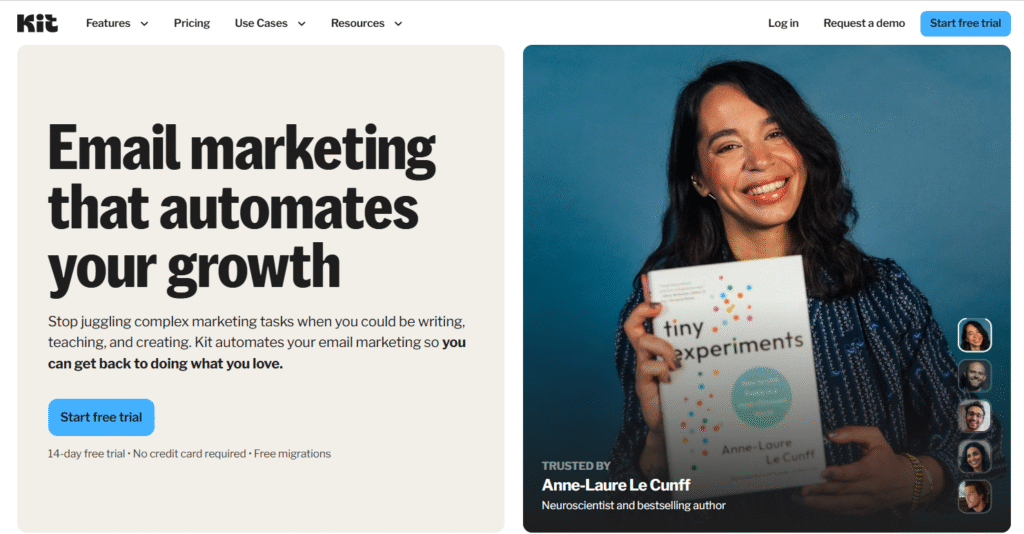
Kit is an AI-first Gmail extension optimised to keep your inbox organized. It automatically prioritizes emails, drafts responses, and surfaces the messages that matter most. (usekite.app) Quick to install and easy to configure, Kite streamlines email management with smart labels, AI search, and automated replies, saving hours each week.
Ideal for professionals, remote teams, and digital innovators, Kite converts the inbox from a time drain into an efficient, goal-driven tool.
Key Features of kit:
- AI Email Writer – Automatically produces engaging content, headlines, and CTAs suited to your campaign strategy.
- Smart Segmentation – Uses AI to analyze subscriber behavior and create dynamic audience segments.
- Automated Campaigns – Enables scheduled, drip, or triggered emails with easy automation flows.
- A/B Testing – AI tests multiple versions and evaluates results to find the most impactful messages.
- Integration Ready – Works smoothly with popular CRMs, eCommerce platforms, and analytics tools.
- Performance Insights – Offers advanced metrics like engagement score, conversion probability, and deliverability rate.
- Drag-and-Drop Editor – Simple and responsive email design without coding, using professional templates.
Pros:
- Great AI-Powered Efficiency.
- Strong Automation & Personalization at Scale
- Clean & User-Friendly Interface
- Affordable Pricing plan with rubst feature.
Cons:
- Limited API & Advanced Integrations for free plan.
- Lacks the trust of established platforms.
Overall
Kit is a practical and performance-enhancing email solution for small businesses, bloggers, and digital marketing experts striving to employ AI for stronger audience connection and sales growth.
3. ActiveCampaign
best automation & “autonomous marketing
Overview:
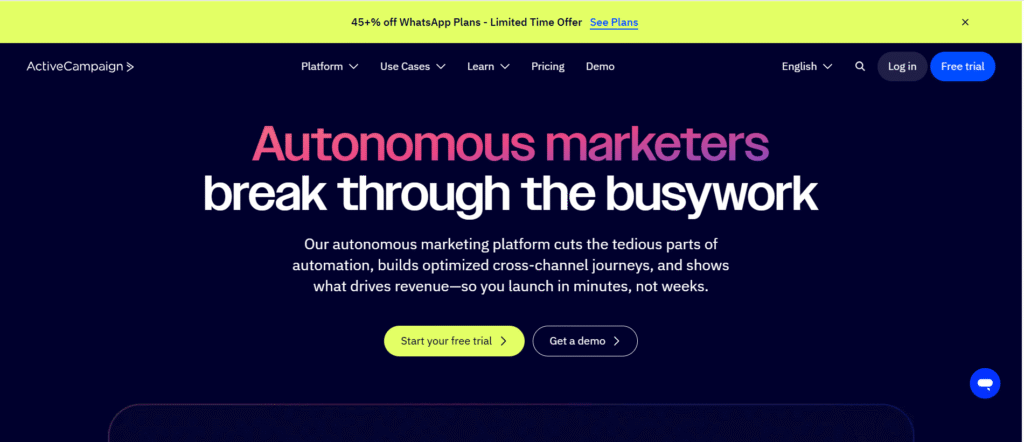
ActiveCampaign is a cloud-hosted platform for email, automation, and CRM, empowering organizations to develop, personalize and send high-performing email campaigns, while also managing customer journeys and sales workflows.
Started in 2003, it’s now a full CX platform with email, SMS and complete customer experience platform.
It is well-suited for small to mid-sized businesses, agencies and marketers who want more advanced automation (vs basic broadcast email tools).
Key Features of ActiveCampaign:
- Advanced Email Designer & Templates – Easy email builder featuring 125+ ready templates and AI tools that design layouts matching your brand style.
- Deliverability & AI-Assisted Optimization – The platform emphasizes deliverability (inboxes, not spam) and uses AI to suggest send times, subject lines, content.
- Integrated CRM & Sales Automation – Beyond email, you can manage contacts, deals, pipelines, nurture leads through to sale, bridging marketing and sales.
- Multi-Channel Capabilities – Email is core, but you can also add SMS, site messages, chat and integrate with other channels, making for a more unified customer experience.
- Broad Integrations – Connects with 900+ tools, making it flexible to integrate with your WordPress site, affiliate platforms, e-commerce, analytics, etc.
Pros:
- Powerful Automation & Scalability.
- Excellent Delivery Rates & Inbox Focus
- All-in-one Marketing & CRM Platform
- Strong Segmentation & helpful Personalisation
- Solid Integrations & Ecosystem Campaign
Cons:
- Steep learning curve for beginners.
- Pricing increases with list growth
- No free plan available.
Overall
For your use-case (you’re running affiliate marketing, tech products, building systems, possibly scaling), ActiveCampaign is a very strong choice. It offers the automation, segmentation, deliverability and integration capabilities you likely need to build high-performing email campaigns and nurture sequences.
4.Hubspot
best for CRM-powered enterprise marketing
Overview
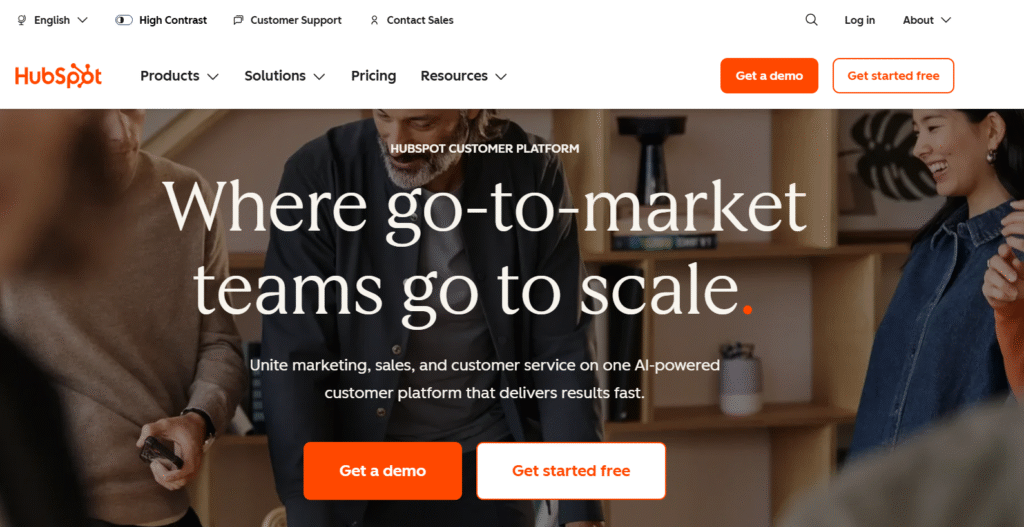
HubSpot Marketing Hub is one of the most comprehensive email marketing and leading automation systems in the field. Its capabilities are part of its broader Marketing Hub suite, tightly integrated with its CRM and other marketing/sales tools .This integration allows you to create, personalize, send, automate, and analyse email campaigns in a unified environment.
Every email interaction — opens, clicks, conversions — is tracked within HubSpot’s CRM, helping businesses understand and optimize the customer journey from the first touchpoint to final conversion.
Key Features Of Hubspot:
- Drag-&-Drop Email Editor & Templates – Create professional, responsive emails in HubSpot using its ready-made templates and beginner-friendly visual design tool.
- Segmentation & Targeting – You can build dynamic lists based on behaviour, demographics, lifecycle stage, etc., and target accordingly.
- Workflow Automation / Triggered Emails – Set up automated sequences (drip campaigns, follow-ups, behaviour-based sends) via workflows tied to contacts and their behaviour.
- CRM Integration & Personalization – HubSpot’s unified contact data enables rich personalization and links every email to the customer’s journey.
- Analytics & Insights –Smart analytics with detailed open, click, and conversion tracking.
- A/B Testing – Ability to test different subject lines, content variations, sending times to optimise results.
- Deliverability & Compliance Tools – The platform safeguards deliverability while helping marketers stay compliant with evolving email laws
✅Pros:
- All-in-one environment ecosystem.
- High-quality personalization & CRM targeting.
- Scalable for growth and complex automation.
- Good analytics and feedback loop.
❌Cons:
- Cost / Value may be high for small/simple use cases.
- Learning curve / complexity for advanced use
Overall
HubSpot is ideal if you want advanced automation, CRM insights, and scalable email marketing. For basic newsletters, however, a simpler, cheaper tool might be better.
5. Brevo
best value + multi-channel for SMBs
Overview.
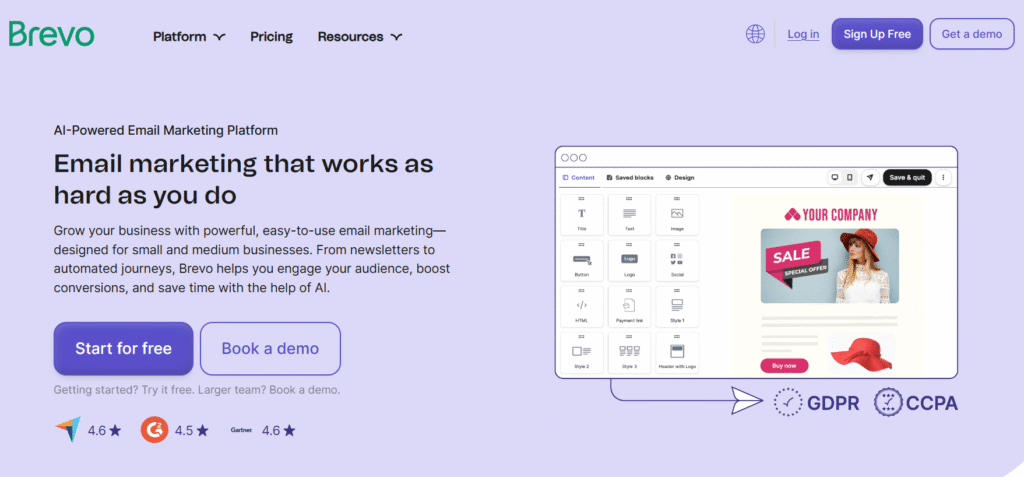
Brevo is a multi-channel marketing platform that helps businesses connect, automate, and grow. It lets small and medium-sized brands manage email, SMS, WhatsApp, and automation effortlessly from one intuitive dashboard.
Known for its budget-friendly plans and cross-channel features, Brevo delivers impressive functionality at a fraction of the usual price.
It helps growing brands unify their customer communication across email, SMS, and more. That balance of performance and affordability makes it a standout choice for SMBs.
Key Features of Brevo:
- Email campaign builder & responsive templates
A drag-and-drop editor for emails plus a library of responsive templates and the ability to code custom HTML if needed. - Marketing automation/workflow builder
Automatic triggers based on user actions (e.g., opens, clicks, website visits) to send follow-ups, nurture sequences, abandoned cart reminders etc. - Segmentation & personalization
You can segment contacts by behaviour, attributes, demographics etc., and customise content accordingly. - Multi-channel capability
In addition to email: SMS campaigns, WhatsApp messaging, live chat, push notifications – all from the same platform. - Built-in CRM and contact management
Store and manage your contacts, track interactions, manage deals/tasks (in some plans) to link marketing & sales.
.
Pros:
- Cost-effective plans with a surprisingly powerful free tier
- Enables seamless multi-channel communication across email, SMS, WhatsApp, and chat — all managed from one platform.
- Intuitive drag-and-drop email builder for easy campaign creation.
- Automation workflows for welcome sequences and lead nurturing.
- Powerful performance tracking and reporting to optimize marketing results..
- Dynamic personalization and segmentation for targeted campaigns.
Cons:
- Limited advanced automation compared to enterprise platforms.
- Template customization options can feel somewhat restrictive.
- CRM and reporting tools lack depth for larger teams.
Overall
If your email marketing goals include building a list of subscribers, sending regular newsletters, automating basic flows (welcome, engagement, segments) and integrating with other tools (e.g., your website, landing pages, funnel), Brevo is a very solid choice. It offers a lot of value, especially for budget-conscious marketers, with a strong free tier and good core features.
6. GetResponse
Best for webinars, funnels & marketing automation
Overview
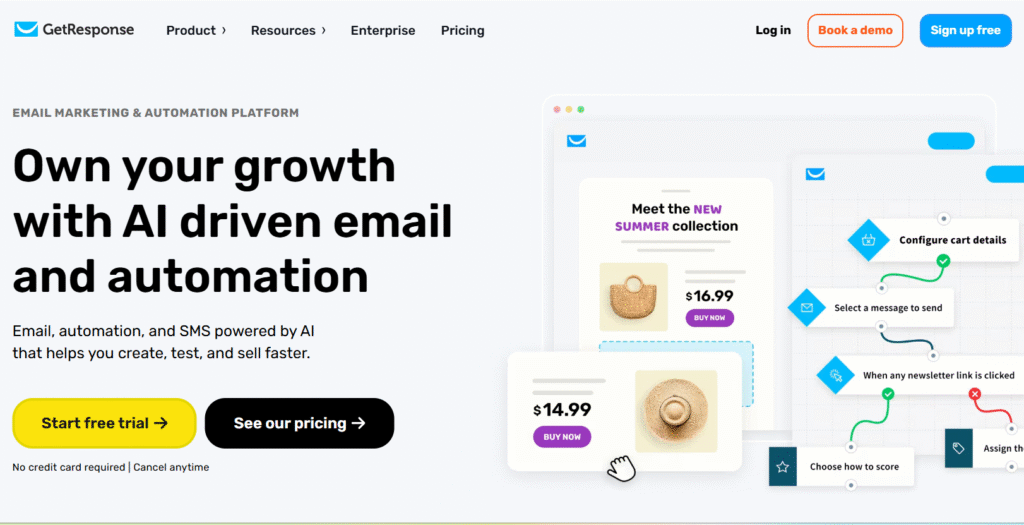
GetResponse is a powerful all-in-one platform for email marketing and automation, helping brands expand their reach and increase conversions.It unites automation engines, conversion pages, and e-commerce platforms to strengthen a complete growth-focused marketing system.
It combines AI-powered email creation with end-to-end funnel management — making marketing smarter, faster, and more effective.
If you’re in affiliate marketing and blogger as you are, GetResponse could help you build email lists, nurture leads, send automated campaigns and integrate with your blog/site funnel.
Key Features of getResponse
- Drag-and-Drop Email Creator & Templates: Design high-quality emails effortlessly with drag-and-drop tools and flexible templates.
- Advanced Segmentation & List Management: Segment your subscribers based on behaviour, tags, custom fields; manage lists and deliver more personalised email campaigns.
- Marketing Automation & Workflow Builder: Build automated sequences and trigger-based workflows (welcome emails, abandoned cart, behavioural triggers) using visual automation tools.
- AI-Driven Tools: AI email generator for subject lines and copy, campaign-generator wizards to speed creation of assets and workflows.
- Analytics & A/B Testing: Measure performance, experiment with subject lines, and improve campaigns on the go.
✅Pros:
- Website builder is basic compared to dedicated platforms.
- Beginner-friendly interface with templates and AI-assisted tools for quick setup.
- automation workflows and Scalability..
- Strong Integrations for Works with popular e-commerce platforms.
❌Cons:
- Advanced automation and high-volume tools aren’t available on basic plans.
- Templates and analytics may not meet the needs of power users.
Overall
GetResponse is a very strong contender in the email marketing and automation space, particularly well-suited if you want more than just basic newsletter blasts — if you’re building a funnel, capturing leads, automating sequences, and monetising via your niche (tech products like hosting/themes/plugins/SEO tools) then GetResponse gives you the toolkit to do so.
7. Constant Contact
best for small businesses & event marketing
Overview
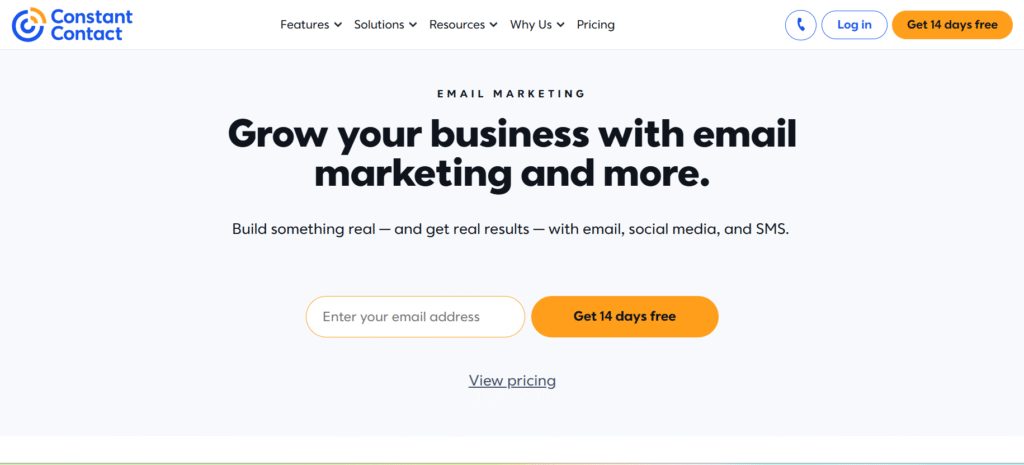
Constant Contact is a cloud‑based well-established email marketing and digital marketing platform designed primarily for small to mid‑sized businesses. Effortlessly create campaigns, automate follow-ups, organize contacts, connect your channels, and track results in real time.
If you’re looking for a reliable, straightforward email marketing system with support and good deliverability, Constant Contact is a credible choice.
Key Features of Constant Contact:
- Drag-and-Drop Email Editor + Templates: .It’s a user-friendly email marketing platform for small businesses, offering campaigns, automation, contact management, integrations, and performance tracking.
- Contact List Management & Segmentation: Upload and organize contacts, build forms, target segments, and integrate effortlessly with your CRM or e-commerce tools.
- Marketing Automation & Triggered Emails: Automate onboarding, event-based, and behavior-driven emails easily; deeper automation features come with upgraded plans.
- Multi-Channel Marketing Tools: Beyond email marketing: includes posting/ads on social platforms, SMS campaigns, landing pages, forms, and event management.
- Integrations & E-commerce Support: Integrates with many third-party systems: e-commerce (Shopify, WooCommerce), CRM (Salesforce), lead generation tools.
Pros:
- Beginner-Friendly & Easy setup.
- High Deliverability & Reliability
- Strong customer support via phone, chat, and tutorials.
- Reliable deliverability ensures emails reach inboxes.
- Solid Template Library & Branding Tools
- Value for Small Businesses / All-in-One Marketing
Cons:
- Automation & Advanced Features Are Limited Compared to Competitors.
- Pricing increases significantly as your contact list grows.
- Templates and analytics may feel basic for power users.
Overall
For small independent business owners, nonprofits, or anyone wanting a simple yet reliable email marketing tool, Constant Contact is a very good choice. Its strengths lie in usability, deliverability, support, and a broad feature set that covers more than just email.
8. Klaviyo
Best for ecommerce & commerce-driven personalization
Overview
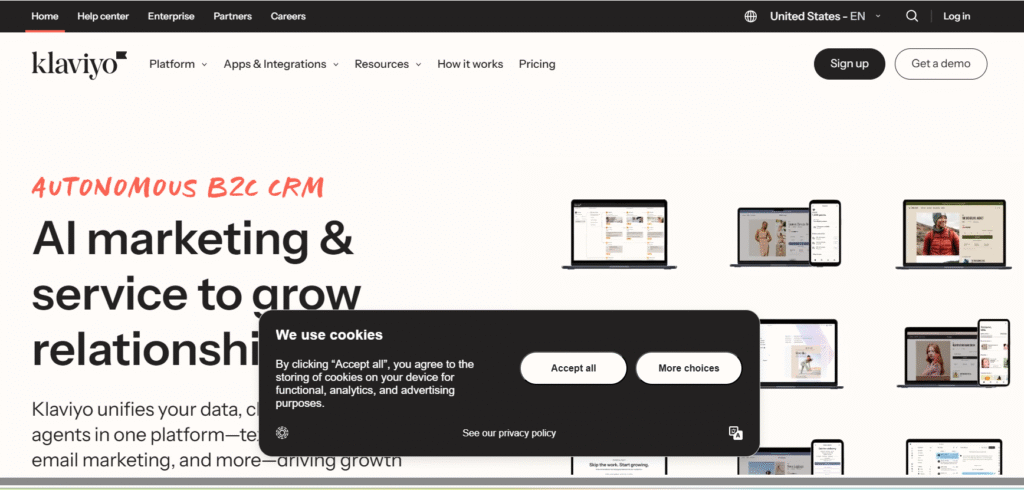
Klaviyo is a marketing-automation platform originally built for . If you are serious about email marketing as part of your affiliate business, Klaviyo is a very strong choice. Best suited for scaling businesses looking to automate targeted, high-converting email flows.
Integrated with Shopify, WordPressWooCommerce, BigCommerce, and Magento, Klaviyo automates segmentation and targeted messaging.
Its core advantage is analytical marketing—using data, trends, and forecasts to drive better results.
Key Features of Klaviyo:
- Deep Segmentation & Data Platform – Klaviyo’s built-in data platform allows you to segment audiences using almost any data point (purchase history, site behavior, predicted lifetime value) and update profiles in real-time.
- Behavior-Triggered Flows / Automation – You can build automated email flows (also across channels) triggered by behaviors like cart abandonment, browsing, purchase, inactivity etc.
- Cross-Channel Capability – Although email is core, Klaviyo supports SMS, mobile push and integrates multiple channels so you can coordinate email + SMS + push in one workflow.
- Drag-and-Drop Email Builder + Templates – You don’t need heavy coding: you get pre-built templates, a visual builder, ability to design responsive emails and manage content blocks.
- AI / Predictive Analytics – Klaviyo uses predictive analytics (e.g., predicting customer lifetime value, churn risk), and has optimizations like “Smart Send Time” to deliver the right message at the right time
- Revenue Attribution & Analytics – It provides strong analytics showing how much revenue each email or flow generates, enabling you to link email campaigns to actual business outcomes—not just opens and clicks.
- Ecommerce Platform Integrations – Native strong integrations with Shopify, WooCommerce, BigCommerce etc, which makes it easier for ecommerce brands (and tech‐product sellers) to connect purchase data, behaviour, product catalogues and email.
✅Pros:
- Powerful personalization for every audience.
- Workflows operate on autopilot, increasing revenue and freeing time.
- Provides clear visibility into email-driven earnings.
- Ideal for eCommerce and affiliate marketers..
❌Cons:
- Pricing may be high for growing businesses.
- Complex for beginners lacking structured automation.
Overall
If you are serious about email marketing as part of your affiliate business, Klaviyo is a very strong choice. Best suited for scaling businesses looking to automate targeted,high-converting email flows.
9. MailerLite
best all-rounder for SMBs and straightforward growth
Overview
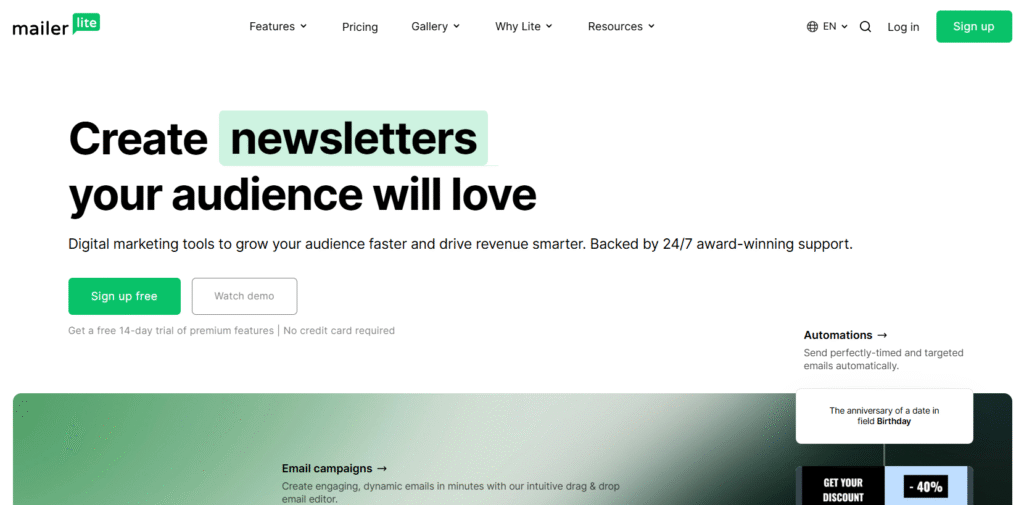
MailerLite is a versatile all-in-one platform for SMBs, ideal for steady growth, designed for growing businesses that value simplicity and efficiency. It provides tools for building email campaigns, automations, landing pages & websites, sign-up forms/pop-ups, and e-commerce/digital product sales.
If you want a straightforward, user-friendly alternative to complex enterprise software, MailerLite is worth considering.
Key Features of MailerLite:
- Drag-and-Drop Email Editor – Design branded, engaging email campaigns visually — no coding needed — with reusable blocks, dynamic content, countdowns, and interactive surveys.
- Automations & Workflows – Visual automation builder: trigger by forms, link clicks, purchases, segment join, etc; branch logic and delays included.
- Landing Pages / Websites / Forms / Pop-ups – Beyond email: build landing pages or mini-websites, deploy pop-ups and signup forms to capture leads.
- Segmentation & Personalisation –Utilize subscriber behavior, location, and custom data to personalize emails — dynamically showing or hiding content for each recipient.
- A/B Testing & Smart Sending – Test subject lines, send times, content variations; leverage “smart sending” to optimise delivery timing.
- E-commerce / Digital Product Support – Integrate with shops (Shopify, WordPress–WooCommerce), and sell digital products or paid newsletters directly..
Pros:
- User-Friendly Interface especially beginners..
- Generous Free / Low-Cost Entry without huge investment
- Comprehensive Feature Set for Growth.
- Authentication & Good Deliverability Practices.
- All-in-One Toolkit & straight forward.
Cons (2)
- Less Advanced for Enterprise / Complex Needs.
- Account Approval & Some Free Tier Limitations.
Overall
Especially given your interest in affiliate marketing, building up an audience and creating email sequences, MailerLite is a very solid choice. When you scale to very large subscriber lists, require deep segmentation, complex multi-channel attribution, or enterprise-grade workflows, you may start bumping into its limits and may need to evaluate higher-end platforms.
10. Omnisend
best eCommerce-focused automation & omnichannel marketing
Overview
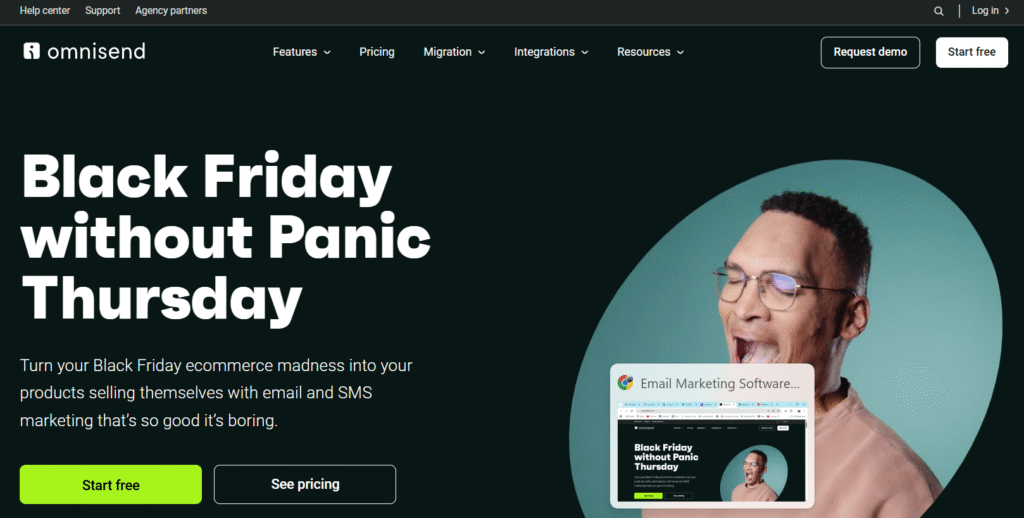
Omnisend is an email marketing and all-in-one marketing platform focused on eCommerce growth. It goes beyond basic newsletters, offering automation, personalization, and multi-channel outreach via email, SMS, and push notifications.
It’s positioned as an “all-in-one ecommerce marketing” tool: build your list, automate flows, send campaigns — all across channels.
It integrates perfectly with major platforms (Shopify, WooCommerce, BigCommerce, etc) and provides templates, drag-and-drop builders, and prebuilt automations to support e-commerce businesses.
Key Features of Omnisend
- Drag-and-Drop Email Builder & Templates – Create branded emails with no coding required, using built-in templates and dynamic content blocks.
- Automation Workflows & Triggers – Pre-built workflows (abandoned cart, welcome series, post-purchase, win-back) and ability to trigger based on behavior.
- Segmentation & Personalization – Build dynamic segments based on behavior (purchases, opens, clicks), location, life-cycle stage; personalize content accordingly.
- Omnichannel Capabilities (Email + SMS + Push Notifications) – Beyond email: integrated SMS and web push so you can reach customers across channels under one roof.
- Product- & E-commerce-Specific Tools – Product recommendation blocks in emails, discount code integration, store sync, etc — particularly useful for stores..
- Large Integration Ecosystem & Migration Support – 160+ integrations and flexible APIs; migration support from platforms like Mailchimp, Klaviyo.
Pros:
- Mainly focus on e-commerce for Online Store.
- User friendly interface and intuitive workflow.
- Omnichannel under one roof of customer combined
- Strong automation & segmentation..
- Value for money (especially for small-to-mid e-commerce) .
Cons:
- Limited design flexibility compared to advanced competitors.
- Deliverability rates can fluctuate on larger campaigns.
- Higher-tier features become costly for small stores.
Overall
If you’re selling shoes, digital products, or hosting/WordPress themes (as you’re interested in) and you want to automate email campaigns, segment by behavior, tie in product offers and possibly use SMS/push down the road, Omnisend offers a perfect value.
I’ve been browsing online more than 3 hours today, yet I never found any interesting article like yours. It is pretty worth enough for me. In my opinion, if all site owners and bloggers made good content as you did, the net will be a lot more useful than ever before.