
How to Write Product Reviews That Rank on Google: Complete SEO Guide


If you want to learn how to write product reviews that attract readers and rank on Google, focus on more than product features. Provide original research, real-world insights, honest pros and cons, and clear recommendations.
Google’s review guidance focuses on creating content with real experience, original perspectives, supporting evidence, and helpful comparisons rather than simply summarizing a product’s features.
A strong product review should answer questions such as:
- What is the product?
- What are its main strengths and weaknesses?
- How does it perform in real-world use?
- How much does it cost?
- How does it compare with alternatives?
The goal is not simply to rank—it is to help readers make better buying decisions while creating useful, trustworthy content that can naturally earn search visibility.
1. Understand Search Intent

Before writing, understanding search intent helps you create a review that matches the reader’s needs. “Hostinger review” suggests a broad evaluation, “Hostinger vs SiteGround” requires a comparison, and “Hostinger pricing” is primarily about cost.
Identify Search Intent
Focus on commercial-investigation keywords such as:
- [Hostinger] review
- is [Hostinger] worth it?
- [Hostinger] pros and cons
- [Hostinger] pricing
- [Hostinger] alternatives
- [Hostinger] vs [SiteGround]
- [Hostinger] for beginners
Then analyze Google’s top results. Look at their content depth, structure, pricing, comparisons, FAQs, images, and testing evidence.
Find important gaps and make your review stronger with original screenshots, real testing, detailed pricing analysis, useful comparisons, and actionable recommendations.
2. Choose the Right Product to Review

The right product should have demand, buying intent, quality, and enough depth for you to provide original insights. Use Google Keyword Planner, Google Trends, Ahrefs, Semrush, or Ubersuggest to discover search opportunities and relevant long-tail keywords.
Before promoting a product, understand its commission structure, cookie duration, and payout terms. Your recommendation should always be based on reader value.
A strong review starts with genuine product experience. Test the product yourself, record your findings, and highlight its key strengths, weaknesses, and limitations.
3. Research the Product and Analyze Top-Ranking Competitors

Research the product from multiple reliable sources instead of depending entirely on its official website.
Verify important claims and collect details about features, specifications, pricing, plans, compatibility, integrations, limitations, support, refunds, and discounts.
- Research Customer Experiences: Analyze customer feedback to identify common strengths, complaints, performance issues, support problems, and missing features. Don’t rely on individual comments; look for patterns across multiple reliable sources.
- Analyze Competitor Reviews: Study the top-ranking pages and identify what they cover well and where they lack depth. Examine their testing, screenshots, pricing analysis, comparisons, pros and cons, and alternatives, then use those gaps to add original research and useful insights.
Note: Make your review more helpful, original, and decision-focused.
4. Create a Clear Product Review Evaluation Framework

Image Cradit: www.evalcommunity.com
Before giving your final verdict, establish a simple and consistent evaluation framework. This helps you compare the product objectively and gives readers a clear reason behind your rating.
Depending on the product, consider:
- Features
- Performance
- Ease of use
- Pricing and value
- Customer support
- Security
- Overall experience
If you rate a product 4.5/5, explain what contributed to the score and what could be improved. A meaningful rating should be backed by real testing, evidence, and clear reasoning.
5. Write a Strong Introduction

Make the first few paragraphs clear, direct, and buyer-focused. Readers should understand the product and your overall opinion without having to read the entire review first.
Include the most important details:
- Best for: Beginners and small businesses
- Overall rating: 4.5/5
- Starting price: $X/month
- Key advantage: Simple and user-friendly
- Main drawback: Advanced features cost more
Your introduction should quickly cover what the product does, who it’s designed for, how you evaluated it, your overall impression, and what the review will cover.
6. Analyze Features, Performance, Ease of Use, and Pricing
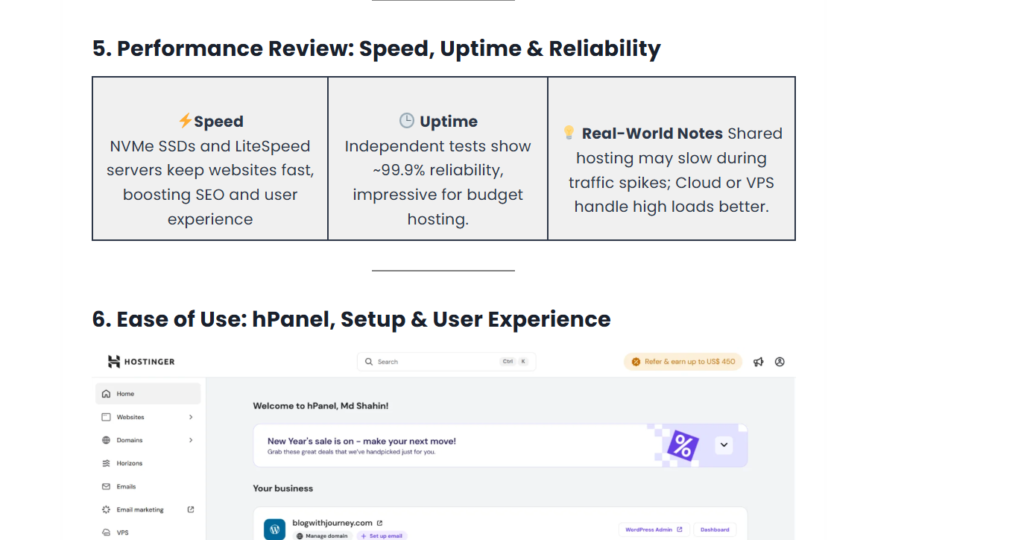
A strong review explains why the product’s features matter, rather than simply listing them. Discuss their usefulness, target users, performance, and limitations.
- Evaluate Performance: Include real-world results where possible, such as loading speed, processing time, accuracy, uptime, battery life, or response time.
- Evaluate Ease of Use: Review the setup, interface, navigation, learning curve, documentation, and overall user experience.
- Analyze Pricing and Value: Don’t stop at the monthly or annual price. Explain what users get, renewal rates, extra costs, trials, refunds, and plan restrictions to show the real value.
7. Show the Pros, Cons, Limitations, and Overall Value
Give readers an honest look at both the good and the bad. Don’t focus only on features or positive points; explain where the product delivers value and where it may disappoint.
Highlight the Pros such as:
- Easy setup
- Strong performance
- Useful features
- Reliable support
- Competitive pricing
Highlight real cons such as:
- Expensive premium plans
- Missing features
- Limited integrations
- Learning curve
- Performance limitations
Help readers understand who the product is designed for and who may outgrow it. Don’t hide important limitations or weaknesses.
8. Compare the Product With Its Main Competitors
Help readers understand the product’s position in the market by comparing it with two to four realistic alternatives. Consider price, features, performance, ease of use, support, integrations, and overall value.
Focus on the differences that can affect the buyer’s decision. Explain the strengths, weaknesses, and overall value of each option rather than simply copying specifications.
A clear comparison gives readers the information they need to choose confidently and avoid selecting a product that doesn’t match their requirements.
9. Use Original Images, Screenshots, Data, and Testing Evidence
Original visuals and testing evidence can make your review more credible and useful. Show readers real examples instead of relying only on product descriptions.
- Add Original Screenshots: For software, capture the dashboard, settings, key features, setup process, pricing, and results.
- Add Original Photos: For physical products, show the packaging, design, components, size, build quality, and product in use.
- Include Testing Data: Where relevant, share measurements, performance results, testing conditions, and comparison data. Every visual should add useful information, not simply fill space.
10. Optimize Your Product Review for SEO and Long-Tail Keywords
SEO should help your product review reach the right audience. Start with a primary keyword, then build a small group of related keywords around the same search intent.
Use the main keyword in the title, introduction, H1, relevant headings, URL, meta description, alt text, and body where appropriate. Avoid forcing exact-match keywords into every paragraph.
Use a clear SEO title such as “How to Write Product Reviews That Rank on Google: Complete SEO Guide.” Keep the URL short and descriptive.
Note: Focus on search intent, helpful information, and natural optimization.
11. Build Internal Links and Add Product Review Structured Data
Use internal links to guide readers from your review to related products, comparisons, alternatives, and helpful guides. Choose natural anchor text that clearly describes the linked page.
Where relevant, add Product, Review, or AggregateRating structured data to help search engines understand your content.
Only mark up real information—never create fake ratings or reviews.
12. Use Affiliate Links, Disclosures, and Effective CTAs

Affiliate links can generate revenue, but your review should never feel like a sales page. Put useful information and reader trust before commissions.
- Disclose Affiliate Relationships: Tell readers clearly when you may earn a commission from qualifying purchases. A short, visible disclosure is usually enough to explain the relationship.
- Add Links at the Right Moments: Place affiliate links naturally after recommendations, pricing details, feature discussions, comparisons, and your overall verdict. Only link when the reader is likely to find it useful.
- Create Natural CTAs: Use relevant phrases such as “Check the Latest Price,” “View Current Plans,” “Try the Product,” or “Compare Pricing.” The best CTA feels like a helpful next step—not a hard sell.
Final Takeaway
A product review becomes valuable when it combines accurate information, first-hand insights, original evidence, balanced analysis, and useful recommendations.
Build every review through a consistent process: research the search intent, choose the right product, analyze competitors, test it, gather evidence, evaluate it fairly, optimize the page, monetize naturally, and keep it updated.
When you consistently put readers first, you create reviews with greater potential to rank, earn trust, and generate affiliate revenue.






Woah! I’m really enjoying the template/theme of this blog.
It’s simple, yet effective. A lot of times it’s very difficult to get that “perfect balance” between superb
usability and appearance. I must say that you’ve done a amazing job with this.
Also, the blog loads super fast for me on Firefox. Outstanding Blog!
Appreciate the depth in this piece. For end-to-end AI song generation, see Happy Shrimp at /. Happy Shrimp